Wild Bees in Winter

by Nick Dorian, Ph.D. - Pollinator Pathway Advisory Board Member
Finally: sweater weather. In the early October sun, bumble bees nuzzle into a blanket of wood-asters.
A patchwork leaf-cutter bee hurries up a wand of goldenrod, her belly held high in the air. Green sweat bees glimmer like flecks of light, and others, smaller and darker, dance across the garden like shadows.
For several weeks this fall, I spent mornings with the bees in my backyard, coffee in hand, watching as they sipped nectar and made arrangements for the long winter ahead. By the time cold had settled on the city, the bees had vanished with the flowers, but I knew they’d both be back next year. As an ecologist, I have spent a decade unraveling the mysteries of bee life cycles, with particular interest in what bees are up to when they are away from flowers.
So, what were the bees up to? Bees have two main strategies for surviving winter.
Strategy 1: Fatten up
The first strategy is to fatten up. Sweet nectar from fall-blooming flowers is converted into internal lipid and carbohydrate stores, much like how other animals fatten up before lean times. Having feasted on nectar and found a mate, females tuck into overwintering sites known as hibernacula. Males, having already mated, die with the onset of cold.
Females typically return to their natal nest for winter, whether an underground burrow, a hollowed-out stem, or a rotting log. Bumble bee queens take a slightly different approach, excavating new hibernacula just inches below the surface. How bees select wintering sites is still somewhat of a mystery, but our understanding has been aided greatly by observant gardeners who report their discoveries to citizen science programs like iNaturalist and Queen Quest.

This strategy is adopted by a minority of the nearly 500 bee species in New England, mainly social bees like bumble bees (Bombus spp.) and some solitary sweat bees like bicolored striped sweat bees (Agapostemon virescens) and pure green sweat bees (Augochlora pura). Since only females survive the winter, these species exhibit two distinct activity periods the following year: an early-season window when mated females emerge to nest and a second late-season period when both males and females—the offspring of spring nests—emerge to mate.
Strategy 2: Leave behind a legacy
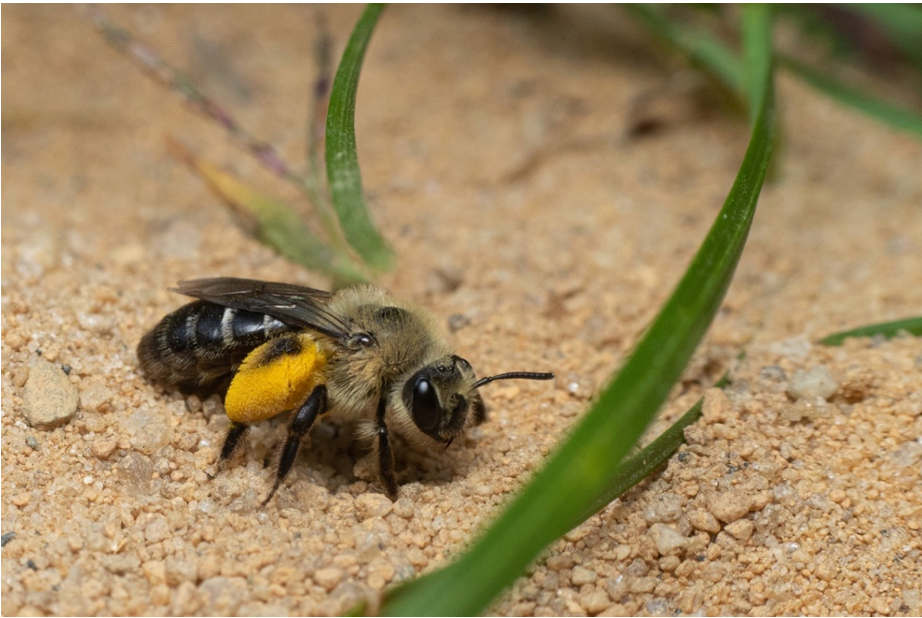
Not all bees fuel up on flowers before winter. Instead, a second strategy exhibited by many solitary bees is to leave behind a legacy—to reproduce before winter and leave offspring to survive in the nest. Take aster mining bees (Andrena asteris). Males and females are common fall visitors to gardens across the eastern US, but the adults you see will die before Thanksgiving. Only their offspring pass the winter underground, resume development in spring on food provisions within the nest, and emerge in fall to repeat the cycle.
Diapause: not just life on pause
Regardless of strategy, all overwintering bees enter a physiological state of dormancy known as diapause during which they slow how fast they live. Metabolism drops by over 95% to help conserve energy, enabling survival over long periods without the need to dip too much into fat stores.
However, diapause is not just life on pause. Critical regulatory and physiological pathways are still at work under the surface that, among other things, allow a bee to successfully cue seasonal activity after winter. Diapause is necessary for bees to emerge in the same way that cold stratification is necessary for native seeds to germinate. In other words, bees in temperate climates have evolved to not simply tolerate winter—rather, they require it.
Stewardship Guidelines
Bees in winter may be out of sight, but they can’t be out of mind. When we steward our garden according to some simple guidelines, we can ensure the survival of bees from one year to the next:
Plant fall-blooming native plants: Asters and goldenrods produce energy-rich nectar that is the lifeline for fall-active bees, regardless of overwintering strategy.
Leave the leaves: A light layer of leaves over garden beds provides safe wintering homes for bumble bees and some ground-nesting species without smothering next year’s plants. Leave stems standing to benefit adults of leaf-cutter, resin, masked, and small carpenter bees by creating habitat structure. (A simple sign can reveal to neighbors your good intentions!)
Leave soils intact (i.e. no tillage) in spring to avoid disturbing overwintering bees.
And, finally, having taken these actions, remember the enduring value of spending time with the bees in your garden. Move slowly and pay close attention. Which bees are drinking nectar, and which bees are collecting pollen? Are certain flowers visited more often than others? How might these observations offer clues about the strategies that bees use to survive winter? Often the answers to our questions about the natural world are hiding in plain sight.
Nick Dorian, Ph.D. (nicholasdorian.com) is a New England-based ecologist, speaker, and consultant. Nick studies and publishes on the ecology and conservation of wild bees and native plants, and he develops awardwinning strategies to enhance biodiversity within the built environment. He is a cherished public speaker, coauthor and photographer of watchingbees.com, and teaches an annual course at Eagle Hill Institute.